

XI'AN TAIMA BIOLOGICAL ENGINEERING CO.LTD
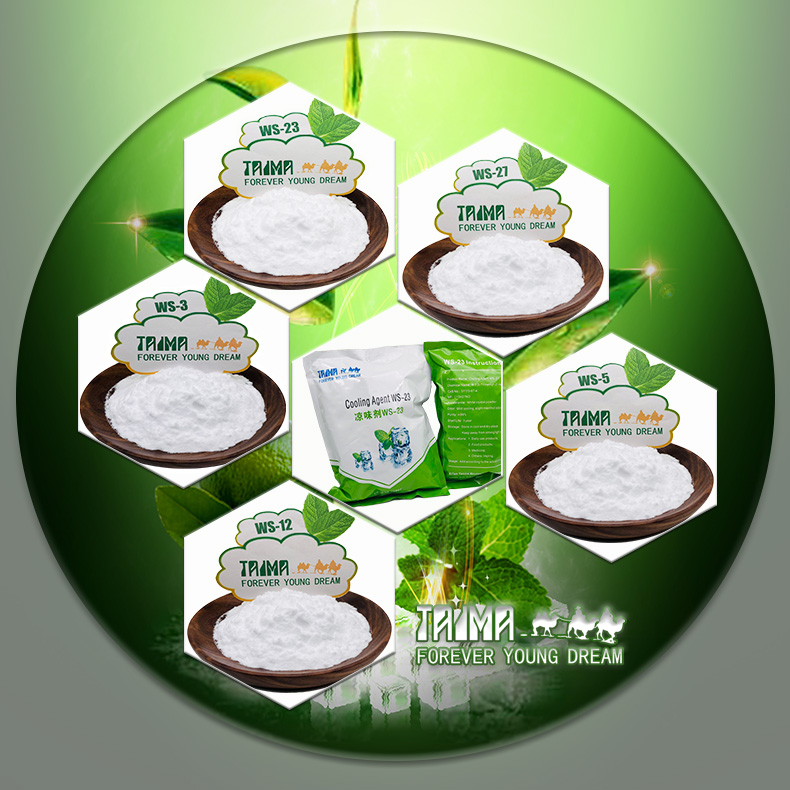
Choosing the right cooling agent is not only about cooling strength. In confectionery, chewing gum, beverages and oral care products, the best cooling system depends on onset speed, cooling duration, sensory location, processing conditions and carrier compatibility. This guide compares WS-23, WS-3, WS-5 and WS-12 to help formulators build cleaner and more controlled cooling profiles.
The demand for clean and refreshing cooling sensations is growing across confectionery, beverages, chewing gum, oral care, and functional flavor applications. Consumers increasingly expect a smooth, long-lasting cooling effect in sugar-free mints, hard candies, functional waters, chewing gum, and lozenges, without the strong medicinal note, bitterness, or burning sensation commonly associated with traditional menthol.
To achieve this type of controlled sensory performance, flavor developers often use synthetic cooling agents from the WS series. Unlike menthol, these cooling agents can provide different cooling speeds, sensory locations, and duration profiles, allowing formulators to build a more precise and layered cooling experience.
Cooling agents do not physically lower the temperature of the mouth. Instead, they create a cooling perception by activating cold-sensitive receptors, especially TRPM8 (Transient Receptor Potential Melastatin 8), which are located on sensory nerve endings in the mouth and throat.
Different cooling molecules interact with the sensory system in different ways. Their molecular structure, polarity, solubility, and formulation carrier can influence how quickly the cooling effect appears, where it is perceived, and how long it remains noticeable during consumption.
For practical formulation work, this means that the best cooling agent is not always the strongest one. The right choice depends on the product format, processing temperature, carrier system, target flavor profile, and the desired sensory curve.
The following table summarizes the typical sensory roles and processing considerations of several commonly used cooling agents in food, beverage, confectionery, chewing gum, and oral care applications.
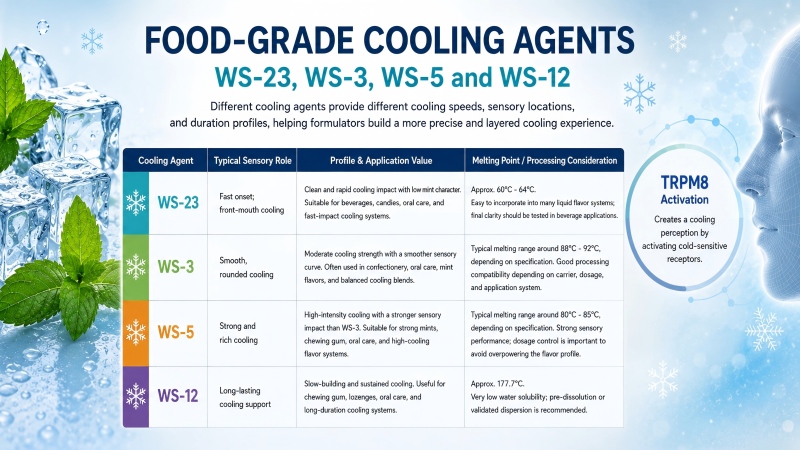 Comparison of WS-23, WS-3, WS-5 and WS-12 cooling agents for beverage, confectionery, chewing gum and oral care applications.
| Cooling Agent | Typical Sensory Role | Profile & Application Value | Melting Point / Processing Consideration |
|---|---|---|---|
| WS-23 | Fast onset, front-mouth cooling | Clean and rapid cooling impact with low mint character. Suitable for beverages, candies, oral care, and fast-impact cooling systems. | Approx. 60°C - 64°C. Easy to incorporate into many liquid flavor systems; final clarity should be tested in beverage applications. |
| WS-3 | Smooth, rounded cooling | Moderate cooling strength with a smoother sensory curve. Often used in confectionery, oral care, mint flavors, and balanced cooling blends. | Typical melting range around 88°C - 92°C, depending on specification. Good processing compatibility depending on carrier, dosage, and application system. |
| WS-5 | Strong and rich cooling | High-intensity cooling with a stronger sensory impact than WS-3. Suitable for strong mints, chewing gum, oral care, and high-cooling flavor systems. | Typical melting range around 80°C - 85°C, depending on specification. Strong sensory performance; dosage control is important to avoid overpowering the flavor profile. |
| WS-12 | Long-lasting cooling support | Slow-building and sustained cooling. Useful for chewing gum, lozenges, oral care, and long-duration cooling systems. | Approx. 177.7°C. Very low water solubility; pre-dissolution or validated dispersion is recommended. |
A single cooling agent may not provide the full sensory experience required in a complex food or beverage matrix. In many applications, formulators use a layered cooling system, where one cooling agent provides fast onset and another supports longer-lasting cooling.
This approach is especially useful in products where the consumer expects both an immediate refreshing impact and a cooling sensation that remains noticeable throughout the consumption cycle.
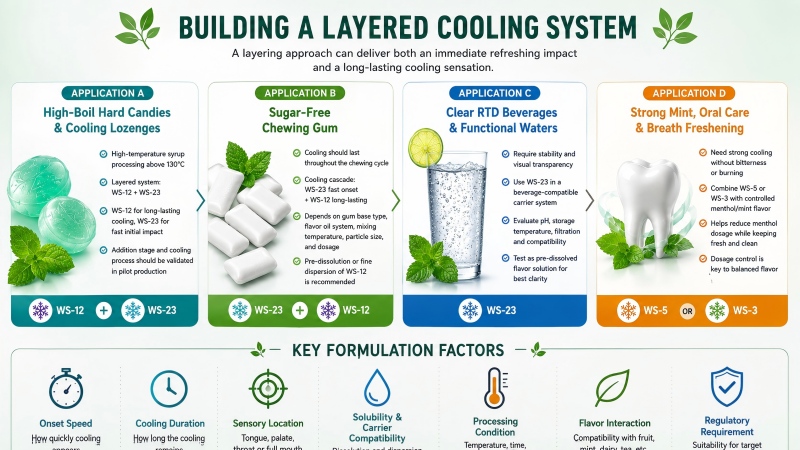 A layered cooling system can combine fast onset and long-lasting cooling for hard candy, chewing gum, beverages and oral care products.
Formulation Challenge: Hard candy and lozenge production may involve high-temperature syrup processing, commonly above 130°C. Cooling agents can lose impact depending on volatility, addition stage, residence time, carrier compatibility, and cooling process.
Recommended Approach: A layered cooling system using long-lasting WS-12 with food-grade WS-23.
Technical Logic: WS-12 has a high melting point and a long-lasting sensory profile, making it a useful candidate for sustained cooling in confectionery and lozenge systems. WS-23 can be added to support a faster initial cooling impact. For best performance, the addition stage and cooling process should be validated in pilot production rather than relying on melting point alone.
Practical Note: In high-temperature confectionery systems, the final cooling performance depends on processing time, addition point, moisture level, flavor carrier, and cooling-agent dispersion. Small-batch trials are recommended before scale-up.
Formulation Challenge: Chewing gum requires a cooling profile that remains noticeable over an extended chewing cycle. Highly water-dispersible components may release too quickly into saliva, causing the cooling sensation to fade before the gum base is fully consumed.
Recommended Approach: A cooling cascade using high-purity WS-23 for fast onset and WS-12 for longer-lasting support.
Technical Logic: WS-23 provides quick initial cooling perception, while WS-12 can help extend the cooling curve due to its slower sensory release and more hydrophobic character. The final performance depends heavily on gum base type, flavor oil system, mixing temperature, particle size, and dosage.
Production Note: Avoid adding WS-12 as untreated dry powder into the gum base without proper dispersion. Pre-dissolution or fine dispersion in a validated flavor carrier is recommended to reduce crystallization, uneven distribution, or localized cooling intensity.
Formulation Challenge: Clear beverages require cooling agents to remain stable and visually transparent without sedimentation, turbidity, or off-notes. This is especially important in citrus, berry, mint, tea, and functional water systems.
Recommended Approach: Use WS-23 in a beverage-compatible carrier system.
Technical Logic: WS-23 is widely used where a clean, fast cooling effect is required with limited mint character. In clear beverages, the carrier system, final dosage, pH, storage temperature, filtration process, and compatibility with other flavor components should be evaluated to prevent haze or precipitation.
Practical Note: For transparent beverage applications, it is better to test WS-23 as a pre-dissolved flavor solution rather than adding dry powder directly into the water phase.
Formulation Challenge: Breath freshening products often require strong cooling impact, but excessive menthol may create bitterness, burning, or an overly medicinal taste.
Recommended Approach: Combine high-intensity WS-5 or WS-3 with a controlled level of menthol or mint flavor.
Technical Logic: WS-5 can provide strong cooling intensity, while WS-3 offers a smoother and more rounded cooling sensation. These materials can help reduce dependence on high menthol dosage while maintaining a fresh and clean sensory profile.
Practical Note: Dosage should be carefully controlled. Strong cooling agents can easily dominate the flavor profile if the formulation is not balanced with sweetness, acidity, mint character, or fruit notes.
Next: Food Additives Neotame
Tel: +86-029-81110978
Mobile Phone: +8613319277267
Email:catherine@taimacn.com

