

XI'AN TAIMA BIOLOGICAL ENGINEERING CO.LTD
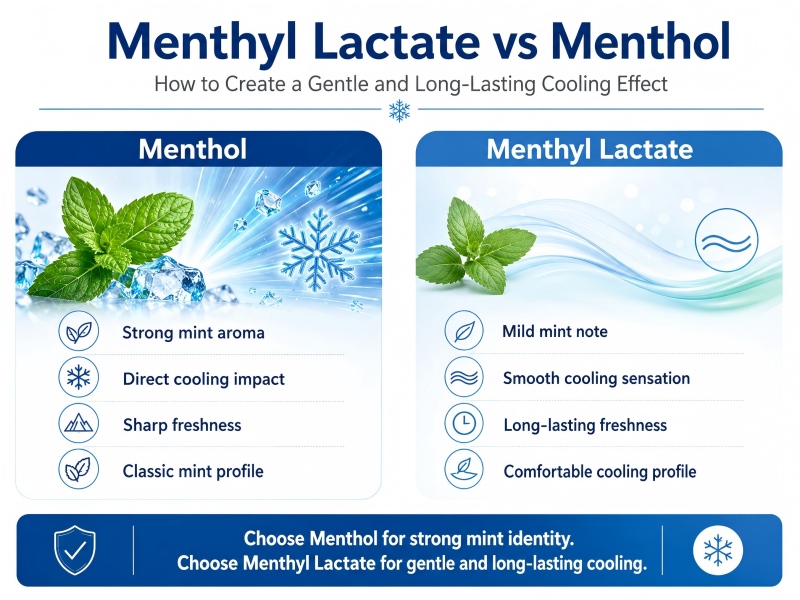
Menthol and Menthyl Lactate are both used to create a cooling sensation, but they do not provide the same sensory profile. Menthol is known for its recognizable mint aroma and direct cooling impact, while Menthyl Lactate is often selected when a gentler, smoother and longer-lasting cooling effect is required.
Article Focus: Menthyl Lactate vs Menthol | Gentle Cooling Effect | Long-Lasting Freshness | Mild Mint Profile | Cooling Ingredient Selection
In many cooling formulations, the key question is not only whether the product feels cool, but also how the cooling effect starts, how long it lasts, how much mint aroma it brings, and whether the final sensation is sharp or comfortable.
This is why Menthyl Lactate and Menthol are often evaluated differently in oral care, confectionery, beverage, food flavor and personal care formulations. Menthol can provide a stronger mint identity, while Menthyl Lactate is more suitable when a mild and long-lasting cooling profile is preferred.
Menthol is a well-known mint ingredient with a strong cooling sensation and a clear mint aroma. It is widely used in mint flavors, oral care products, confectionery, chewing gum and other products where a recognizable mint profile is desired.
However, menthol may feel too sharp or too mint-dominant in some formulations. When a softer cooling effect is needed, formulators may consider menthol-derived cooling ingredients or WS cooling agents according to the target sensory profile.
Menthyl Lactate, also known as L-Menthyl Lactate, is a menthol-derived cooling ingredient used to provide a mild, smooth and long-lasting cooling sensation. Compared with menthol, it usually gives a softer cooling profile with a milder mint note.
For product specification, sample evaluation and document support, please visit our Menthyl Lactate Cooling Agent product page.
Menthol: Direct, recognizable and stronger mint cooling. It is suitable when a clear mint impact is required.
Menthyl Lactate: Mild, smooth and longer-lasting cooling. It is suitable when a softer and more comfortable cooling effect is preferred.
Formulation Direction: Menthol is useful for strong mint identity, while Menthyl Lactate is useful for gentle freshness and extended cooling perception.
Menthol has a strong and recognizable mint aroma, which can strongly influence the final flavor or fragrance profile. This is an advantage in classic mint products, but it may not be ideal when the formulation requires a cooling effect without an overpowering mint character.
Menthyl Lactate usually provides a milder mint note and a smoother cooling sensation. This makes it suitable for products where cooling should support the formulation rather than dominate the entire sensory profile.
Menthol is commonly used when a strong mint freshness is needed. Menthyl Lactate can be considered when the formulation requires a smoother and longer-lasting freshness, such as in toothpaste, mouthwash and breath freshening products.
In candy and chewing gum, menthol can provide a strong mint identity, while Menthyl Lactate can help create a pleasant and longer-lasting cooling effect. The final choice depends on the desired flavor release and cooling duration.
For beverage and food flavor systems, Menthyl Lactate may be selected when a gentle cooling sensation is required without a strong mint-dominant taste. Application trials are recommended to confirm the best use level and sensory balance.
In personal care formulations, Menthyl Lactate can be used when a comfortable and mild cooling feeling is desired. The final suitability should be confirmed according to formulation type, use level and destination market requirements.
Choose Menthyl Lactate when the target is gentle, smooth and long-lasting cooling.
Choose Menthyl Lactate when the formulation should not be dominated by strong mint aroma.
Choose Menthol when the product needs a clear, recognizable and classic mint cooling profile.
Evaluate Together when the formulation requires both mint identity and extended cooling sensation.
Next: Food Additives Neotame
Tel: +86-029-81110978
Mobile Phone: +8613319277267
Email:catherine@taimacn.com

