Sugar reduction is becoming an important formulation direction for beverage, confectionery, dairy, bakery and tabletop sweetener products. However, reducing sugar is not only about replacing sweetness. It may also affect mouthfeel, sweetness onset, sweetness duration, flavor balance and consumer acceptance.
Advantame E969 is a food grade high-intensity sweetener used in sugar-reduced food and beverage formulations. It is approximately 20,000 times sweeter than sucrose, depending on the food application, which means only a very small amount is normally required to reach the target sweetness level.
For food and beverage formulators, Advantame is usually evaluated as part of a complete sweetness system, where dosage accuracy, dispersion, taste balance, processing conditions and local food additive regulations all need to be considered.
If you are looking for commercial supply information, TAIMA also provides Advantame E969 food grade sweetener for sample testing and bulk procurement.
Why Advantame E969 Is Used in Sugar-Reduced Formulations
Many food manufacturers need to reduce sugar while keeping the product close to the original sensory profile. This can be challenging because sugar contributes not only sweetness, but also body, texture, flavor release and overall taste balance.
Advantame E969 is selected by formulators mainly because of its very high sweetness potency and low dosage requirement. In many product systems, it can provide strong sweetness contribution without adding a large amount of replacement solids.
Formulation Focus: Because Advantame is used at a very low level, accurate weighing, pre-dilution and uniform dispersion are often more important than simply comparing sweeteners by sweetness intensity.
Key Technical Features of Advantame E969
Approximately 20,000 Times Sweeter Than Sucrose: Advantame provides extremely high sweetness potency, helping formulators reduce the total sweetener dosage in finished formulations.
Low Dosage and Cost-in-Use Advantage: Because only a very small amount is required, Advantame can be evaluated where sweetness intensity, low use level and formula cost efficiency are important.
Suitable for Sugar-Reduced Formulations: It can be used in product development for reduced-sugar beverages, confectionery, dairy products, bakery products, tabletop sweetener blends and flavor systems.
Processing Suitability: Advantame may be evaluated in applications where formulators need better processing suitability than some early-generation sweeteners. Final performance should always be confirmed according to pH, processing temperature and storage conditions.
Sweetener Blending Flexibility: It can be blended with other sweeteners to adjust sweetness onset, sweetness duration, aftertaste and overall taste balance.
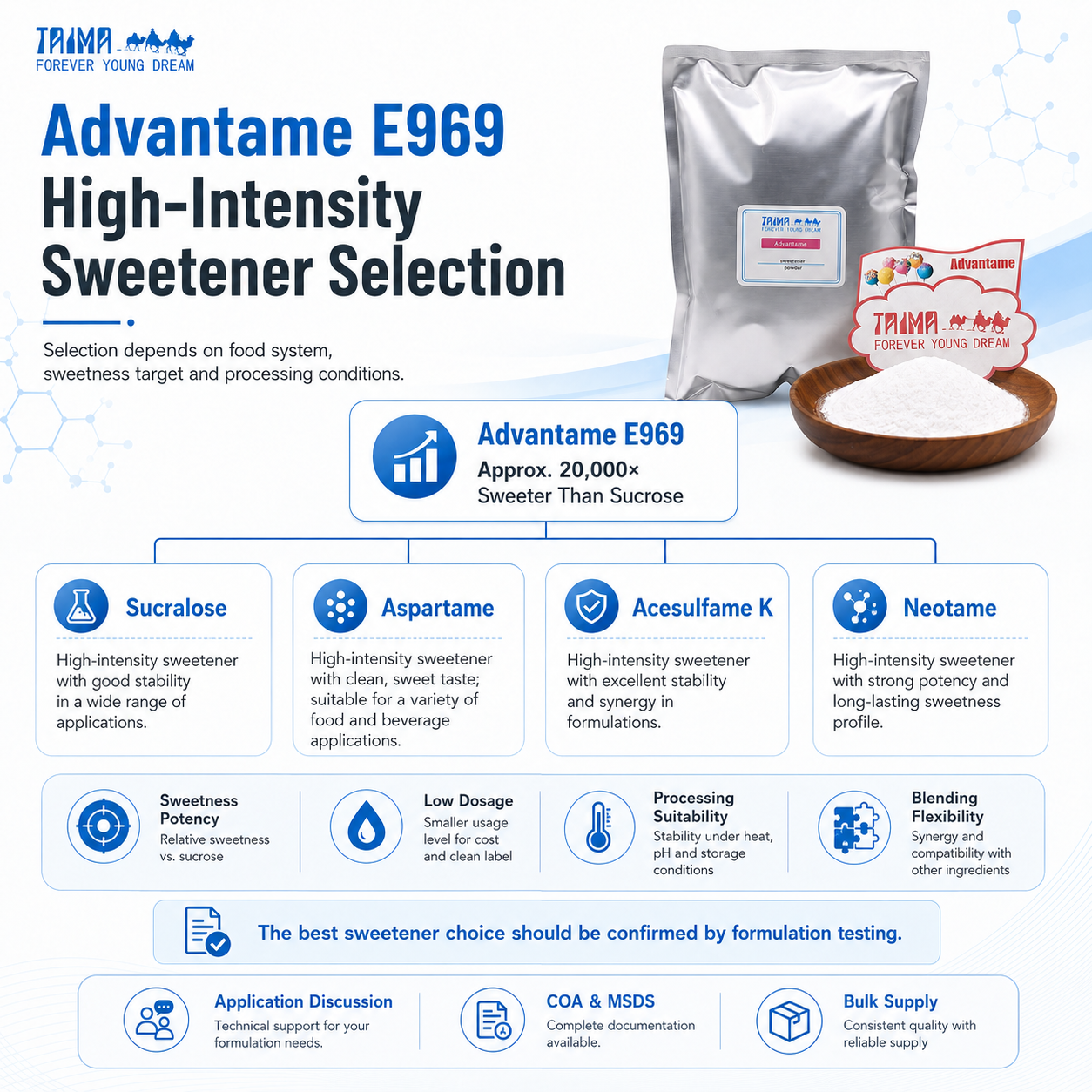
Advantame E969 vs Common High-Intensity Sweeteners
Compared with common high-intensity sweeteners, Advantame E969 is mainly selected for its very high sweetness potency and low dosage requirement. This makes it useful for formulators who want to reduce total sweetener addition while still achieving strong sweetness intensity.
Compared with aspartame, Advantame may be evaluated in applications where better processing suitability is required. Compared with sucralose, acesulfame K or neotame, Advantame may offer a different sweetness curve and blending profile depending on the food system.
However, no single sweetener is the best choice for every product. Sucralose, neotame, acesulfame K, aspartame and Advantame may all perform differently depending on pH, heat process, flavor system, sweetness target and local food additive regulations.


